

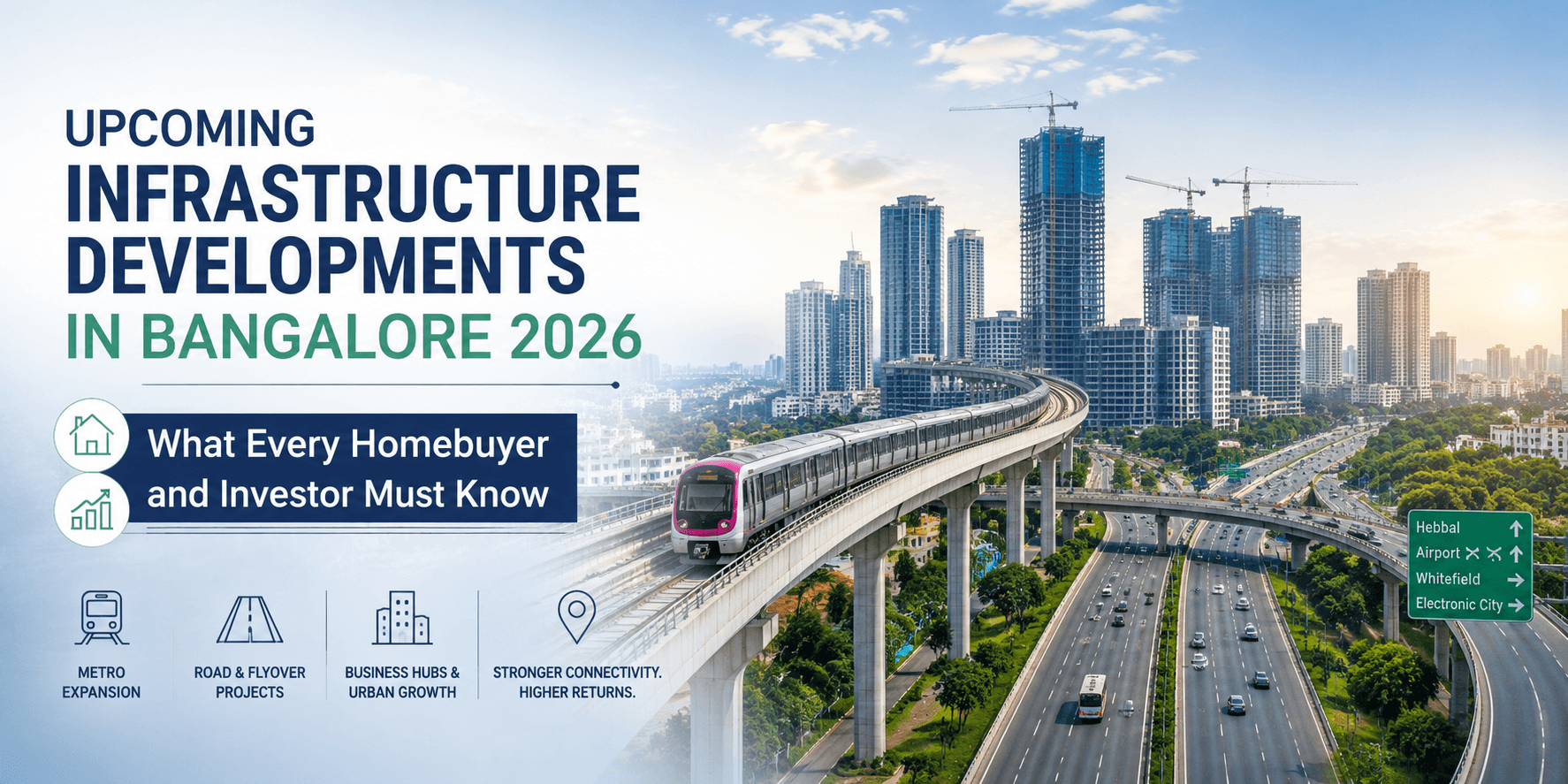
Upcoming Infrastructure Projects in Bangalore 2026: What Every Homebuyer and Investor Must Know
Bangalore has never stood still. From a quiet garden city to India’s undisputed technology capital, it has consistently reinvented itself. And in 2026, the city is on the verge of another defining transformation — one driven not just by startups and software, but by concrete, steel, and connectivity.
A wave of large-scale infrastructure projects is either already underway or approaching completion. Elevated corridors, metro extensions, ring roads, and suburban rail networks are reshaping how people move across the city. And wherever infrastructure moves, real estate follows — with capital appreciation, rental demand, and livability all rising in step.
If you are a homebuyer, an investor, or an NRI evaluating residential options in Bangalore, understanding these developments is not optional. It is the difference between buying early in a growth corridor and arriving late to a party that already made everyone else wealthy.
This guide breaks down every major upcoming infrastructure project in Bangalore for 2026 and beyond, explains which micro-markets they unlock, and helps you identify where your investment rupee can work the hardest.
Why Infrastructure Is the Strongest Driver of Real Estate Appreciation
Before diving into the projects, it helps to understand the mechanism.
Infrastructure reduces travel time. Reduced travel time expands the catchment area of employment hubs like Electronic City, Whitefield, and the Outer Ring Road tech belt. When more professionals can reach these hubs comfortably from a wider radius, demand for housing in that radius rises. So do prices.
According to research by JLL India, residential properties located within 0–2 km of upcoming metro corridors tend to outperform less-connected locations by 5–25% in capital appreciation over a five-to-seven-year cycle. Bangalore has followed this pattern faithfully — Whitefield, Marathahalli, and Hebbal all demonstrated measurable appreciation surges as metro lines approached them.
The projects launching or maturing in 2026 are following the same logic — but on a much larger scale.
Major Upcoming Infrastructure Projects in Bangalore: 2026 and Beyond
1. Namma Metro Phase 2 and Phase 3 Expansion
Overview
Namma Metro’s Phase 2 expansion, operated by the Bangalore Metro Rail Corporation Limited (BMRCL), is the most consequential urban mobility project in Bangalore’s history. It is extending the network across three key corridors — the Yellow Line (RV Road–Bommasandra) serving Electronic City, and the Phase 2A and 2B Blue Line connecting the city to the airport via Hebbal.
The Yellow Line was officially inaugurated on 10 August 2025 by Prime Minister Narendra Modi — a milestone that gave Electronic City its first-ever direct metro connection. The line spans 19.15 km with 16 stations, running fully elevated from RV Road to Bommasandra.
Phase 3, currently in planning and early approvals, will add new lines connecting Sarjapur Road and Kadugodi to the outer city ring, further integrating Bangalore’s fragmented geography.
Expected Completion Timeline
- Yellow Line (RV Road–Bommasandra): Fully operational since August 2025 — as tracked by The Metro Rail Guy
- Phase 2A/2B (Blue Line / Airport corridor): Targeted 2026–2027
- Phase 3 (including Sarjapur–Hebbal Red Line): 2030 onwards (Cabinet approved Dec 2024; central approval pending)
Areas Impacted
Electronic City, Bommasandra, Hulimavu, JP Nagar, BTM Layout, Silk Board junction, Hebbal, Nagavara, Yelahanka, Kempegowda International Airport (KIAL).
Real Estate Impact
The Yellow Line closes the single biggest livability gap Electronic City has had for decades. According to MagicBricks, the line directly serves tech campuses of Infosys, Wipro, and Tech Mahindra — and has already triggered a surge in buyer demand in Bommasandra and Electronic City. Cushman & Wakefield’s Q1 2026 Marketbeat Bengaluru Report records a 12% rise in housing demand near Electronic City, directly attributed to the new metro access.
The airport metro corridor is simultaneously fuelling appreciation in Hebbal, Yelahanka, and Jakkur — areas increasingly attractive to senior professionals and business travellers.
- Investment Potential: High
2. Peripheral Ring Road (PRR) — Now the Bengaluru Business Corridor Project
Overview
The Peripheral Ring Road — officially rebranded the Bengaluru Business Corridor by the Bangalore Development Authority (BDA) — is one of Bangalore’s most ambitious road infrastructure projects. It is a 73 km, 8-lane access-controlled expressway encircling the outer edges of the city, connecting Tumkur Road in the northwest to Hosur Road in the south via Hessarghatta, Doddaballapur Road, Old Madras Road, and Sarjapur Road.
Its primary purpose is to divert heavy commercial traffic away from the Outer Ring Road while creating a high-speed corridor through which peripheral residential zones can thrive. As Swarajya Magazine reports, the project features 16 flyovers, 10 overpasses, 12 underpasses, and bridges over 7 water bodies including Gunjur Lake.
Expected Completion Timeline
Approved under a PPP-DBFOT model with a target delivery of 2027, as detailed by The Metro Rail Guy’s PRR tracker. Key land acquisition and tender processes are active.
Areas Impacted
Sarjapur Road, Gunjur, Kanakapura Road, Hessarghatta, Doddaballapur Road, Whitefield, Hoskote, and Kempegowda International Airport.
Real Estate Impact
The PRR fundamentally changes the geometry of Bangalore’s real estate. As 99acres analysts observe, the PRR has the potential to become an economic corridor much like the ORR — which has seen massive real estate expansion over the years. Sarjapur Road, already one of Bangalore’s most active residential micro-markets, gains another critical connectivity layer.
- Investment Potential: Very High
3. Satellite Town Ring Road (STRR) Project
Overview
The STRR is a 284-kilometre ring road planned at a wider orbital radius than the PRR, being developed by NHAI (National Highways Authority of India). It passes through satellite towns including Doddaballapur, Nelamangala, Magadi, Ramanagara, Anekal, and Hoskote — all on the outer development ring of greater Bangalore.
The STRR’s goal is to create a self-sustaining growth corridor outside the BBMP boundaries, decongesting the core city while spurring township-level development.
Expected Completion Timeline
Long-term: 2027–2032. Partial sections will open earlier. NHAI is adopting a multi-contractor approach for faster execution.
Areas Impacted
Nelamangala, Doddaballapur, Hoskote, Anekal, Ramanagara.
Real Estate Impact
The STRR is a long-horizon play — its most significant impact will be on integrated township development and plotted investments in peripheral zones. Investors with a 10+ year horizon should watch STRR-adjacent land closely.
- Investment Potential: Moderate to High (long-term)
4. Bangalore Suburban Rail Project (BSRP)
Overview
The Bangalore Suburban Rail Project is the city’s most underrated infrastructure game-changer. Implemented by K-RIDE (Rail Infrastructure Development Company, Karnataka), it is a 149 km commuter rail network with 64 stations across four corridors named after local Kannada flowers — Mallige, Kanaka, Sampige, and Parijaata. The network is funded by a combination of central and state government grants, a €500 million KfW Development Bank loan and a €300 million EIB loan — totalling ₹7,438 crore in foreign financing.
| Corridor | Route | Length |
| Mallige (Corridor 2) | Benniganahalli – Chikkabanavara | ~25 km |
| Kanaka (Corridor 4) | Heelalige – Rajanukunte | ~46.8 km |
| Sampige (Corridor 1) | KSR Bengaluru – Devanahalli | ~41 km |
| Parijaata (Corridor 3) | KSR Bengaluru – Kengeri | ~14 km |
Source: K-RIDE Official / Wikipedia — Bengaluru Suburban Railway
Expected Completion Timeline
Union Minister V Somanna confirmed, as reported by Swarajya Magazine, that the Mallige and Kanaka corridors are targeted for inauguration by December 2026. The Sampige and Parijaata corridors follow in 2027–2028.
Areas Impacted
Whitefield, Baiyappanahalli, Yelahanka, Rajanukunte, Bidadi, Kengeri, Devanahalli, and large swaths of north and east Bangalore.
Real Estate Impact
Suburban rail changes the commuter calculus far more than metro does, because it covers longer distances at lower fares. Areas like Rajanukunte and Bidadi — currently considered distant — become practical daily commute zones. Metro Rail News projects that BSRP will carry 9.84 lakh passengers daily, significantly easing congestion and expanding the city’s effective residential footprint.
- Investment Potential: High (especially peripheral and affordable segments)
5. Signal-Free Corridors and Elevated Expressways
To address Bangalore’s legendary congestion, NHAI and BBMP have been developing a network of elevated corridors and signal-free roads across key arterials. Key projects include:
- Hebbal–KIA Elevated Expressway: Reducing travel time to the airport to under 30 minutes from north Bangalore.
- Silk Board–KR Puram Elevated Corridor: Targeting a 30–40 minute time saving on one of India’s most congested stretches — directly benefiting Bellandur, Marathahalli, and HSR.
- Hosur Road–Electronic City Expressway Extension: Extending elevated connectivity toward Hosur and south Bangalore’s tech zone.
Real Estate Impact
Signal-free corridors have an outsized effect on residential demand in their vicinity. Reduced commute times translate directly to premium pricing power in Bellandur, Marathahalli, and HSR Extension.
6. Airport Connectivity: KIAL Metro and Terminal 2
Kempegowda International Airport is rapidly expanding with a second terminal. Metro Phase 2A/2B will provide direct rail connectivity from the city to the airport for the first time, targeted for the KIAL–Hebbal section to open between June and September 2026.
This is transformative for residential demand in the Hebbal–Yelahanka–Jakkur corridor, where airport proximity is a genuine lifestyle differentiator for senior executives, NRIs, and frequent business travellers.
7. Tech Corridor Expansion: Whitefield, ORR, and Beyond
The Outer Ring Road tech corridor — from Marathahalli to Sarjapur junction — remains Bangalore’s most valuable office address, housing campuses of Amazon, Microsoft, Accenture, IBM, and Cisco. With metro connectivity now operational through Whitefield, residential demand in nearby localities is intensifying.
The planned development of a new IT/ITES zone near Bagalur (north Bangalore) is also worth tracking, as it could seed the next generation of tech-led residential demand in north Bangalore.
Emerging Real Estate Hotspots: Where to Watch in 2026 and Beyond
Based on infrastructure trajectory and market data, the following micro-markets are primed for significant appreciation:
Sarjapur Road
Sarjapur Road has evolved from a peripheral location into one of Bangalore’s most sought-after residential corridors. With direct access to ORR employment hubs, proximity to Electronic City, and major projects drawing families and professionals, the area now sees another tailwind: its inclusion in the PRR alignment and the Karnataka Cabinet-approved Sarjapur–Hebbal Metro Red Line (Phase 3A, December 2024).
According to Anarock Research, Sarjapur Road recorded 63% price appreciation between 2021 and 2024 — from ₹6,050/sq ft to ₹9,850/sq ft — with rental yields averaging 3.5%–5.2%. 99acres price trend data independently shows 98% appreciation over five years and 185% over ten years — one of the steepest long-run appreciation curves in Bangalore real estate.
Localities like Gunjur, Carmelaram, and Doddakannelli offer strong entry-point value for buyers seeking long-term appreciation. Reputed developers who positioned projects here early — including Abhee Ventures, with a residential presence in the Sarjapur Road belt — are now seeing the validation of that foresight.
- 5-year appreciation: ~98% (99acres data)
- Rental yield: 3.5%–5.2% (Anarock, 2024)
- Buyer profile: IT professionals, young families, NRI investors
- Next catalyst: PRR + Metro Phase 3A (Sarjapur–Hebbal Red Line, approved Dec 2024)
Electronic City
Long the backbone of Bangalore’s IT industry, Electronic City is undergoing its most significant livability transformation ever. The Yellow Line metro, inaugurated August 2025, has closed its historic connectivity gap. Cushman & Wakefield (Q1 2026 Marketbeat) records a 12% demand uplift in the Electronic City zone following metro launch.
With 2 BHK and 3 BHK apartments at more competitive price points than ORR or Whitefield, Electronic City offers strong entry-point value with infrastructure-led appreciation now actively underway.
- Price range: ₹6,000–₹9,000/sq ft (post-metro premium forming)
- Infrastructure uplift: Metro Yellow Line (operational) + Hosur Road elevated + STRR
- Office occupancy: Among highest in Bangalore (Infosys, Wipro, HCL, Biocon)
Gunjur
Gunjur sits at the convergence of Sarjapur Road and ORR — a prime intersection of demand corridors. Relatively young as a residential market, it still offers competitive pricing even as its surroundings mature rapidly. Buyers looking for 5–7 year appreciation plays should evaluate Gunjur seriously.
Whitefield
Whitefield’s metro connectivity on the Purple Line has triggered a new wave of residential interest. Premium apartments, gated communities, and luxury villas are absorbing faster since the line activated through Kadugodi and ITPL. The area remains an enduring favourite among mid-to-senior IT professionals.
Hosur Road and South Bangalore Corridor
The Hosur Road belt — connecting Bangalore to the Tamil Nadu border — is gaining from both industrial expansion (the Hosur EV and manufacturing hub) and residential demand from dual-income households. The corridor offers a mix of affordable options and emerging premium residential projects.
HSR Extension and Bellandur
HSR Layout’s extension zones and Bellandur continue to attract demand from ORR-based professionals. Signal-free corridor improvements and proximity to the Silk Board–KR Puram elevated project create further upward pricing pressure in this already-premium belt.
Infrastructure and Real Estate Appreciation: A Comparison Table
| Infrastructure Project | Status | Key Areas Benefiting | Appreciation Potential |
| Metro Phase 2 — Yellow Line (Electronic City) | Operational (Aug 2025) | Electronic City, Bommasandra, JP Nagar | High |
| Metro Phase 2A/2B (Airport Line) | Underway — 2026-27 | Hebbal, Yelahanka, Jakkur | High |
| Peripheral Ring Road (PRR) | Under construction | Sarjapur Road, Gunjur, Kanakapura Road | Very High |
| Satellite Town Ring Road (STRR) | Planning/early work | Nelamangala, Hoskote, Anekal | Moderate–High |
| Bangalore Suburban Rail (BSRP) | Underway — 2026-27 | Whitefield, Rajanukunte, Kengeri, Bidadi | High |
| Silk Board–KR Puram Elevated | Underway | Bellandur, Marathahalli, HSR | High |
| KIAL Metro Connectivity | Underway | Hebbal, Yelahanka, Devanahalli | High |
Source: BMRCL, K-RIDE, BDA, Knight Frank India H1 2025, Cushman & Wakefield Q1 2026 (compiled)
What This Means for Homebuyers and Investors
Buy before completion, not after. Infrastructure projects in Bangalore have historically driven a pattern: prices rise steeply in the 12–24 months before a project opens, not after. The buyers who benefited most from Whitefield’s metro story bought in 2020–2022, not 2023–2024.
- Focus on micro-markets, not just corridors. Not every locality along a new metro line or ring road appreciates equally. Walkability from transit nodes, social infrastructure quality, and builder track record matter enormously.
- Think 7–10 years, not 2–3. Infrastructure-led appreciation is a long-horizon story. Buyers who evaluate projects in Sarjapur Road, Electronic City, and the STRR belt through a 7–10 year lens are far more likely to be satisfied than those expecting quick flips.
- Rental demand is the interim return. Rental demand in tech-adjacent localities remains structurally strong. A well-chosen residential investment near a metro station or tech corridor generates steady income while capital appreciation builds.
Expert Insights: Analyst Perspectives on Bangalore’s Real Estate Trajectory
“Bangalore’s real estate market is no longer driven by one or two micro-markets. The infrastructure wave of 2024–2028 is creating a multiplicity of growth corridors simultaneously. We are seeing genuine appreciation interest from NRIs and institutional investors in locations that were considered too peripheral just three years ago.” — Residential real estate analyst perspective
Knight Frank India’s H1 2025 India Real Estate Report confirms the scale of this momentum: Bengaluru recorded 33,498 residential unit launches in H1 2025 — a 31% year-on-year increase, the highest in recent history. Knight Frank also ranked Bengaluru 4th among 46 global cities for prime residential appreciation (10.2% rise).
Several specific trends are worth tracking for the discerning investor:
1. The South–Southeast Corridor Is Most Active
The Sarjapur Road – Electronic City – Hosur Road triangle is seeing the densest overlap of infrastructure, employment, and residential investment. South Bengaluru led the H1 2025 market with 38% of total residential launches, per Knight Frank.
2. Metro Connectivity Drives Premium Pricing
Properties within 1 km of a metro station command a 12–18% premium over comparable properties further away. Cushman & Wakefield Q1 2026 data shows housing demand rising 19% near metro station zones city-wide, with Electronic City at +12% and Bommanahalli at +8%.
3. Work-from-Office Recovery Is Sustaining Demand
The post-pandemic return to office — partial but steady — has reactivated demand for homes within practical commuting distance of tech campuses. This is sustaining volume in Sarjapur Road, Electronic City, and Whitefield, all of which are active ORR employer zones.
4. Integrated Townships Are Gaining Preference
Buyers are increasingly favouring gated communities and integrated residential projects that bundle connectivity, amenities, open spaces, and community living. Developers who deliver on this promise in growth corridors are outperforming the broader market.
Abhee Ventures has built its residential philosophy around exactly this framework — creating thoughtfully designed communities in locations where infrastructure growth is already underway. Their projects in the south Bangalore belt reflect an understanding that location and design together, not either alone, drive long-term value.
Key Takeaways
- Bangalore’s 2026 infrastructure wave is the most comprehensive in the city’s history — spanning metro, suburban rail, ring roads, and elevated corridors simultaneously.
- Electronic City and Sarjapur Road stand to benefit the most from overlapping infrastructure investments.
- The Yellow Line metro — inaugurated August 2025 — is a watershed moment for south Bangalore’s livability.
- The Peripheral Ring Road (PRR) will unlock Sarjapur Road’s full appreciation potential once complete.
- BSRP will make commuting from peripheral zones viable. Two corridors are targeted for December 2026 delivery.
- Buy before completion is the consistent lesson from Bangalore’s infrastructure history.
- Integrated, well-designed residential communities in growth corridors represent the strongest long-term value proposition.
Conclusion: Investing in Bangalore’s Infrastructure-Led Future
Bangalore’s growth story is not a sprint. It is a marathon with clearly marked milestones — and 2026 is one of the most significant of those milestones.
The city’s infrastructure pipeline — metro lines, ring roads, suburban rail, elevated corridors — is laying the groundwork for a Bangalore that is more connected, more livable, and more valuable than at any previous point in its history. The micro-markets that sit at the intersection of these developments are not just attractive today; they are positioned for compounding appreciation over the next decade.
For homebuyers, the question is not whether to buy in a growth corridor — it is which corridor, which project, and which developer. For investors, the logic is even clearer: infrastructure timelines are public knowledge via BMRCL, K-RIDE, and BDA, but pricing in not-yet-matured markets has not yet fully caught up.
Developers like Abhee Ventures have spent years building in areas where infrastructure was a promise, not yet a reality. As that promise becomes concrete — quite literally — their projects’ residents and investors are among the first to benefit.
If you are evaluating a residential investment in Bangalore in 2026, the time to explore your options is now — before the infrastructure opens, before the prices adjust, and before the opportunity narrows.
Ready to Invest in Bangalore’s Future?
The best time to invest in a growth corridor is before the infrastructure fully arrives. Abhee Ventures has been building thoughtfully designed homes in Bangalore’s high-potential corridors — combining location intelligence with community-first design.
→ Explore Projects | → Schedule a Site Visit | → Talk to Our Investment Advisor
Frequently Asked Questions
Which area in Bangalore will grow the most by 2030?
Based on infrastructure investment and employment density, Sarjapur Road and the Electronic City–Bommasandra corridor are the strongest candidates. Both benefit from metro access, PRR connectivity, and sustained IT sector demand. Anarock Research ranks Sarjapur Road among Bengaluru's fastest-appreciating micro-markets. Gunjur, Whitefield's eastern extension, and the Hebbal–Yelahanka corridor are also strong contenders.
Is Sarjapur Road a good investment in 2026?
Yes. Sarjapur Road is one of Bangalore's strongest residential investment destinations. According to Anarock Research, the corridor saw 63% price appreciation in three years (2021–2024), with rental yields averaging 3.5%–5.2%. The Peripheral Ring Road, the Blue Line metro (Agara/Ibbalur stations), and the approved Phase 3A Red Line (Sarjapur–Hebbal) make the 5–7 year appreciation story here highly compelling.
How will Bangalore Metro expansion impact real estate?
JLL India research indicates residential properties within 0–2 km of upcoming metro corridors outperform less-connected locations by 5–25% in capital appreciation over a 5–7 year cycle. The Yellow Line has already triggered a 12% demand uplift near Electronic City (Cushman & Wakefield Q1 2026). The Airport Blue Line (2026–27) will similarly re-rate the Hebbal–Yelahanka corridor.
Which Bangalore infrastructure projects are nearing completion in 2026?
The Yellow Line metro (operational since August 2025); BSRP Mallige and Kanaka corridors (targeted December 2026 per Union Minister's statement); the Airport Metro Phase 2A/2B initial section (mid-2026 targeted); and ongoing work on the Silk Board–KR Puram Elevated Corridor.
Is Electronic City still a good place to buy property in 2026?
Absolutely. The Yellow Line metro has addressed Electronic City's historic connectivity gap. With property priced at ₹6,000–₹9,000/sq ft — more competitively than ORR or Whitefield — and demand rising 12% post-metro launch (Cushman & Wakefield, Q1 2026), Electronic City offers strong entry-point value with infrastructure-led appreciation now actively underway.
What is the Bangalore Suburban Rail Project and how does it affect real estate?
The BSRP is a 149 km, four-corridor commuter rail network being built by K-RIDE with ₹7,438 crore in foreign funding. Unlike metro, suburban rail covers longer distances at lower fares — making peripheral zones like Rajanukunte, Bidadi, and Yelahanka practical daily commute areas. Two corridors are targeted for December 2026 completion. The project is projected to carry 9.84 lakh passengers daily when fully operational.
What is the Peripheral Ring Road and which areas does it benefit?
The PRR (now called Bengaluru Business Corridor) is a 73 km, 8-lane expressway being developed by the Bangalore Development Authority under a PPP model, targeted for 2027. It connects Tumkur Road to Hosur Road via Sarjapur Road. It significantly boosts investment potential in Sarjapur Road, Gunjur, Whitefield, and Hoskote — by providing seamless bypass connectivity around the city.
Should NRIs invest in Bangalore real estate in 2026?
Bangalore remains one of India's most attractive NRI investment markets. According to Knight Frank India (2024 Residential Index), Bengaluru records 7–10% annual appreciation in key micro-markets. Rental yields of 3.5–5.2% in tech corridors (Anarock, 2024), RERA-backed buyer protections, and rupee depreciation benefits for USD/GBP/AED earners make this a structurally attractive destination.
How much has property appreciated in Bangalore over the last 5 years?
Significantly. Anarock Research notes that Bengaluru's average housing prices rose 57% between H1 2019 and H1 2024. Sarjapur Road specifically appreciated 98% over five years (99acres data). Knight Frank projects continued 8–12% annual appreciation in top corridors through 2030.
What should I evaluate before buying a home in a Bangalore growth corridor?
Key checklist: (1) Infrastructure timeline — how close is the project to completion? (2) Developer track record and RERA registration. (3) Social infrastructure — schools, hospitals, retail within 2 km. (4) Rental demand — check vacancy rates and rental comparables. (5) Resale market liquidity. (6) Project design quality and community amenities — proven to sustain long-term resale value.
Recent Posts

Bangalore Property Rates: What Buyers Should Know in 2026

How to Choose RERA-Approved Projects in Bangalore

